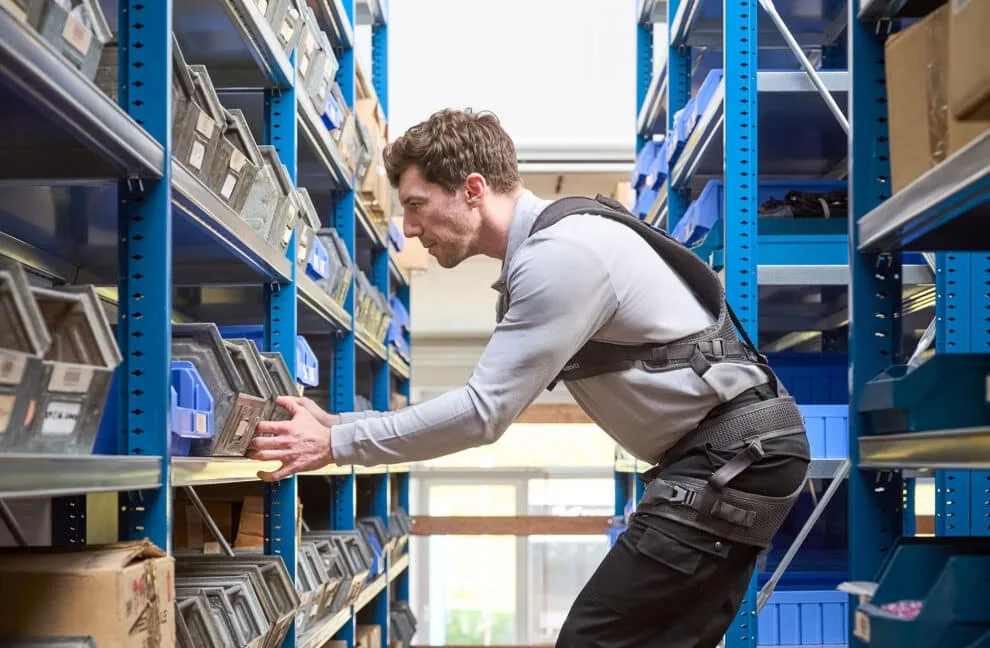
Exoskeletons in Logistics and Handling: Reducing MSDs Daily
How exoskeletons reduce MSDs in warehouses and logistics. Picking, order preparation, loading: solutions tailored to eac
Lire →
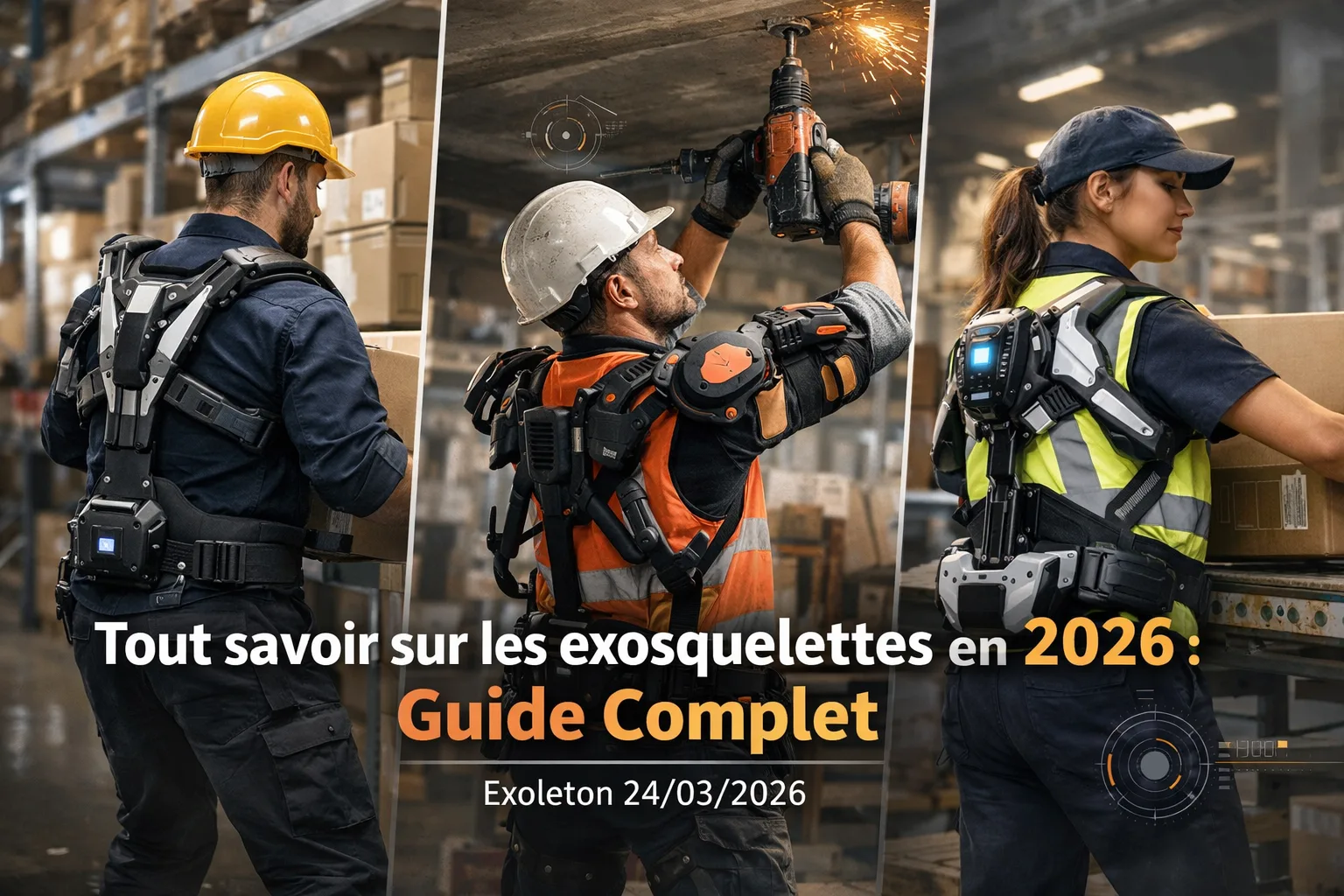
The reference guide to understanding professional exoskeletons: technologies, uses, selection criteria, regulations, funding, and trends for 2026.
Musculoskeletal disorders (MSDs) account for 87% of recognized occupational diseases in France according to Health Insurance. Each year, there are over 44,000 new reported cases, generating estimated direct costs of 2 billion euros for companies and society. In light of this reality, exoskeletons emerge as one of the most promising solutions to reduce physical strain at work.
By 2026, the global market for professional exoskeletons will exceed 3 billion euros, driven by industries such as manufacturing, logistics, construction, and healthcare. Annual growth is estimated at 25-30%, fueled by increased awareness among companies and public incentives. However, behind this figure, the market remains complex: dozens of manufacturers, very different technologies, prices ranging from €500 to over €45,000, and little neutral information to guide professional buyers in their choices.
This guide has been designed to answer all your questions: what is an exoskeleton, how does it work, what types are available, how to choose the right model, how much it costs, what funding options exist to finance the equipment, and what trends to watch for in 2026. Whether you are an HSE manager, site director, ergonomist, or business owner, this guide provides you with the keys to make an informed decision and structure your equipment project.
An exoskeleton is a mechanical or robotic device worn on the body that assists the user's natural movements. Unlike an autonomous robot, the exoskeleton does not replace humans: it enhances their physical capabilities or reduces the strain on certain areas of the body (back, shoulders, arms, legs).
The principle is simple: by absorbing part of the mechanical effort — through springs, elastomers, or motors — the exoskeleton reduces the strain on muscles and joints. The result: less fatigue, less pain, and ultimately, fewer MSDs.
The first exoskeletons were developed in the 1960s for military applications (General Electric's Hardiman). For decades, they remained confined to research laboratories and medical rehabilitation. It was from 2015 that the professional market truly took off, driven by the miniaturization of components and the growing awareness of the costs associated with MSDs.
By 2026, there are more than 80 active manufacturers worldwide, with a growing share in Asia (China, South Korea, Japan) offering high-performance models at competitive prices.
Passive exoskeletons operate without motors or batteries. They use purely mechanical mechanisms — springs, elastomers, counterweights, cable systems — to redistribute forces and lighten muscular effort.
Advantages: lightweight (500 g to 3 kg), no recharging, minimal maintenance, affordable prices (€500 to €3,000), easy for teams to adopt. Their simplicity is their strength: no software to update, no electronic failures, no charging time. An operator can don their passive exoskeleton in 30 seconds and start working immediately.
Limitations: limited assistance (effort reduction of 10 to 40%), less effective on very heavy loads, no dynamic adaptation to effort. Assistance is constant and does not adjust to the intensity of movement.
Typical Use Cases: logistics/warehousing (picking, order preparation), construction (repetitive tasks), industry (assembly positions), agriculture (harvesting, picking). Passive exoskeletons are particularly favored in e-commerce warehouses where pickers perform between 150 and 300 bends per day.
Active exoskeletons incorporate electric motors, sensors, and a battery. They detect the user's movements in real-time using inertial measurement units (IMUs), strain gauges, and sometimes EMG (electromyography) sensors that measure muscle activity. A control algorithm calculates the necessary assistance force in milliseconds and commands the motors accordingly.
Advantages: powerful assistance (effort reduction of 30 to 60%), dynamic adaptation to gestures and loads, customization via software, usable data (number of lifts, hours of use, stress zones). This data allows for objective management of MSD prevention.
Limitations: heavier (3 to 12 kg), limited autonomy (4 to 8 hours depending on usage intensity), high cost (€5,000 to €45,000), more complex maintenance (battery, firmware, sensors), longer adaptation time (1 to 2 weeks vs. a few days for a passive model).
Typical Use Cases: heavy industry (automotive, aerospace), construction (formwork, rebar, demolition), healthcare (patient transfer, caregiver assistance), industrial maintenance (prolonged awkward postures).
Hybrid models combine a passive mechanical structure with occasional motorized assistance. For example, a back exoskeleton whose passive structure absorbs 70% of the load, complemented by a micro-motor that provides a boost during the heaviest loads. They offer a compromise between lightness and power and are beginning to emerge in 2026 as a distinct category.
The "soft exosuits" represent the new frontier. Unlike rigid exoskeletons, they are made from technical textiles, Bowden cables, and soft actuators. Worn like clothing, they are almost invisible under work clothes. The Harvard Biodesign Lab and companies like Seismic or Free Bionics are developing promising models. Their weight drops below 800 grams, and their discretion promotes user acceptance.
This is the most requested area, and for good reason: lower back pain accounts for 20% of work stoppages in France. Back exoskeletons assist during bending, lifting loads, and leaning postures. They act like a "lumbar spring" that returns energy during straightening.
The most common models in 2026: Bisko, PERCKO, Laevo V2, HeroWear Apex, Auxivo LiftSuit.
Upper limb exoskeletons relieve overhead work: painting, plastering, wiring, welding in high positions. They compensate for the weight of the arms through a system of springs or articulated arms.
Reference models: Levitate Airframe, Ottobock Paexo Shoulder, SuitX ShoulderX, Skelex 360-XFR.
Lower limb exoskeletons are aimed at jobs with prolonged standing, frequent squatting, or intensive walking. Some models offer an "invisible seat" (chairless chair), while others assist walking.
Models: Noonee Chairless Chair, Archelis, suitX LegX, Hypershell.
The choice of an exoskeleton depends on several criteria that must be analyzed together, not in isolation:
This is the starting criterion. A back exoskeleton will not relieve the shoulders. Identify precisely the areas of pain or fatigue that are most impactful in your activity.
Light repetitive movements → passive is generally sufficient. Heavy loads (>15 kg) or extreme postures → an active will be more effective. Varied tasks → prioritize versatility and lightness.
An exoskeleton that is too heavy will be rejected by teams. The rule of thumb: less than 3% of the user's weight for a passive (i.e., less than 2.5 kg for a person weighing 80 kg). For an active, the assistance power must more than compensate for the extra weight.
Ensure that the autonomy covers at least a full shift (8 hours). Some models offer interchangeable batteries for continuous operation.
Adjustable harnesses, breathable textiles, preserved freedom of movement. The best exoskeleton is one that you forget you are wearing. Always plan for a trial phase of 2 to 4 weeks before the final purchase.
A passive requires little maintenance (replacement of elastomers every 12-18 months). An active requires regular maintenance (battery, sensors, software). Check the availability of spare parts and the responsiveness of customer service.
Passive: €500 to €3,000 per unit. Active: €5,000 to €45,000. Consider the total cost of ownership (purchase + maintenance + training) and not just the purchase price.
In Europe, professional exoskeletons are governed by several regulatory frameworks:
Machinery Directive 2006/42/EC: active exoskeletons are considered machines and must bear the CE marking. Passives, depending on their design, may be classified as PPE (Personal Protective Equipment).
AFNOR Standard NF EN ISO 18646: currently under development, it aims to standardize methods for evaluating the performance of exoskeletons.
INRS Recommendation: the INRS regularly publishes evaluation guides and feedback on the integration of exoskeletons in companies. Their MAECT methodology (Exoskeleton Analysis Method at the workstation) is a reference.
Several programs allow for partial or total financing of exoskeleton acquisitions:
The Retirement and Occupational Health Insurance Funds offer grants covering up to 70% of the cost of an exoskeleton as part of MSD prevention. The "TMS Pros" program is the main vehicle. Conditions: companies with fewer than 200 employees, commitment to a documented prevention approach.
For workers with disabilities, AGEFIPH (private sector) and FIPHFP (public sector) can finance up to 100% of the equipment as part of workplace adjustments.
Some regions offer specific assistance for innovation or improving working conditions. Check with your CCI or DIRECCTE.
Investment in an exoskeleton is amortizable over 3 to 5 years. Certain configurations may qualify for the innovation tax credit (CII) for SMEs.
The ROI of an exoskeleton is primarily calculated based on the reduction of sick leaves related to MSDs. On average, a sick leave for MSDs costs between €3,000 and €50,000 to the employer (direct + indirect costs: replacement, loss of productivity, increased contributions, impact on team morale).
With a 20 to 40% reduction in MSDs thanks to passive exoskeletons, the return on investment is generally achieved within 6 to 18 months for equipment used by 10 operators. For active models, the timeframe is 18 to 36 months but with a more pronounced impact on the most exposed positions.
However, ROI is not limited to sick leaves. Companies deploying exoskeletons also observe significant indirect gains: improved productivity (less fatigued operators work more efficiently at the end of the day), reduced turnover (improved working conditions retain employees), enhanced employer image (a recruitment argument in tight labor markets), and reduced temporary staffing costs related to replacements.
According to a study conducted by the INRS among 12 industrial companies, the satisfaction rate of equipped operators exceeds 75% after 3 months of use, and the number of reported lower back pain cases decreases by an average of 30 to 45%.
Use our ROI calculator to estimate the return on investment tailored to your specific situation.
1. Buying Without Testing — An exoskeleton that works on paper may be unsuitable for your actual position. Always require a trial period of 2 to 4 weeks.
2. Ignoring Operators — Acceptance by teams is the number one success factor. Involve end users from the selection phase. An exoskeleton rejected by operators will end up in the closet.
3. Focusing Solely on Price — A passive at €500 that is not worn costs more than an active at €8,000 that effectively reduces MSDs.
4. Neglecting Training — Even a passive exoskeleton requires learning. Plan for 2 to 5 days of support for each new user.
5. Not Measuring Impact — Without indicators (wear rate, reported pain, sick leaves before/after), you cannot justify the investment or expand it.
Embedded Artificial Intelligence: active exoskeletons are increasingly integrating AI to adapt assistance in real-time to the user's gesture. IMU sensors and machine learning algorithms allow for automatic personalization.
Miniaturization: advances in composite materials (carbon, Dyneema) and brushless motors allow for a 30% weight reduction in actives over 3 years.
Smart Textiles: the emergence of "soft exosuits" — soft exoskeletons integrated into clothing — blurs the line between protective equipment and exoskeleton.
Democratization of Passive Models: with prices dropping below €500, passive exoskeletons are becoming accessible to small businesses and craftsmen.
Asian Market: Chinese manufacturers (ULS Robotics, Kenqing/Vigx, Fillsense, Dnsys, Zytekno) offer models at prices 30 to 50% lower than European brands, with comparable performance. This increased competition is driving down overall prices and accelerating innovation, directly benefiting European buyers.
Adopting an exoskeleton in a company is not an impulsive purchase. It is a project that is structured in 6 steps:
1. Identify Critical Positions — Which positions generate the most MSDs? Which operators complain the most about pain? Analyze your occupational health data and cross-reference it with absenteeism rates by position.
2. Define the Need Precisely — Body area, type of effort, frequency, work environment (temperature, humidity, confined spaces, specific risks). A back exoskeleton for an air-conditioned warehouse and one for an outdoor construction site in winter will not be the same.
3. Compare Solutions — Use our comparator and our recommendation quiz to identify suitable models. Do not rely solely on manufacturer sheets: seek independent field feedback.
4. Test in Real Conditions — Trial period of 2 to 4 weeks on identified positions. Involve at least 3 to 5 operators to get representative feedback. Measure comfort, spontaneous wear rate, any discomfort, and the perceived impact on fatigue.
5. Measure and Adjust — Monitor indicators (comfort, wear rate, reported pain, sick leaves before/after) and adjust if necessary. Share results with teams: transparency fosters adoption.
6. Train and Support — Even a passive exoskeleton requires learning the right movements. Plan for an internal referent trained by the supplier who can support new users.
Exoleton is here to assist you at every step. Contact us for free, no-obligation advice.
No. The exoskeleton is a complement to gestures and postures, not a substitute. It reduces physical load but does not exempt from training in good practices. The most successful companies combine exoskeletons, ergonomics of positions, and ongoing training for operators.
For a lightweight passive exoskeleton: 2 to 5 days are usually sufficient. For a motorized active: plan for 1 to 2 weeks of gradual use (starting with 2 hours/day and then increasing). The adoption rate exceeds 80% when operators are involved in the model selection from the start.
Light passive models (less than 1.5 kg) can be worn for a full 8-hour shift without major discomfort. For actives, battery autonomy is the limiting factor (4 to 8 hours). It is recommended to schedule 15-minute breaks every 2 hours during the initial adaptation phase.
Professional exoskeletons are not reimbursed by social security as they are not considered medical devices in the regulatory sense. However, they can be financed by CARSAT (up to 70%), AGEFIPH (up to 100% for disabled workers), and various regional aids. Check our funding guide for details on available programs.
A well-maintained passive exoskeleton lasts 3 to 5 years under intensive daily use. Wear parts (elastomers, straps, textiles) are replaced every 12 to 18 months at a moderate cost. An active has a lifespan of 3 to 7 years, with battery replacement every 2 to 3 years and regular firmware updates.
Yes, most professional exoskeletons are designed to be compatible with standard PPE (helmet, gloves, safety shoes, high-visibility vest). However, check specific compatibility with fall protection harnesses (EN 361 standard), which may interfere with certain back models. Always request validation from the manufacturer.
Active exoskeletons collect usage data (movements, duration of wear, loads). This data is subject to GDPR in Europe. It must be anonymized and cannot be used to individually monitor employees without their explicit consent. Check the manufacturer's data policy before purchase.
How exoskeletons reduce MSDs in warehouses and logistics. Picking, order preparation, loading: solutions tailored to eac
Lire →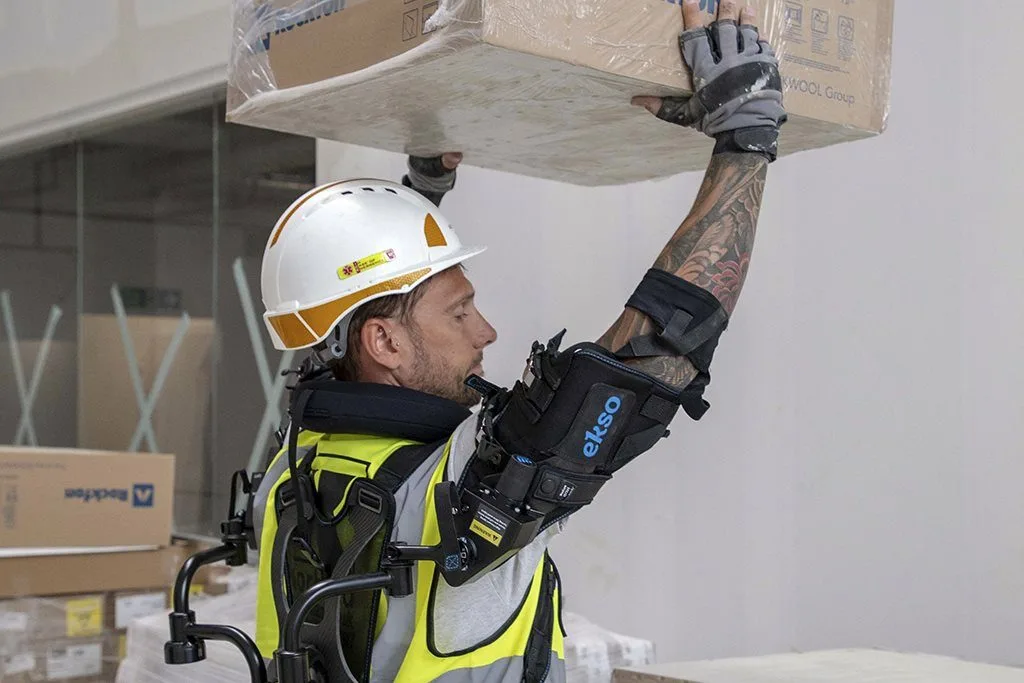
Practical guide to choosing an exoskeleton suitable for construction jobs: mason, plumber, electrician, painter, roofer.
Lire →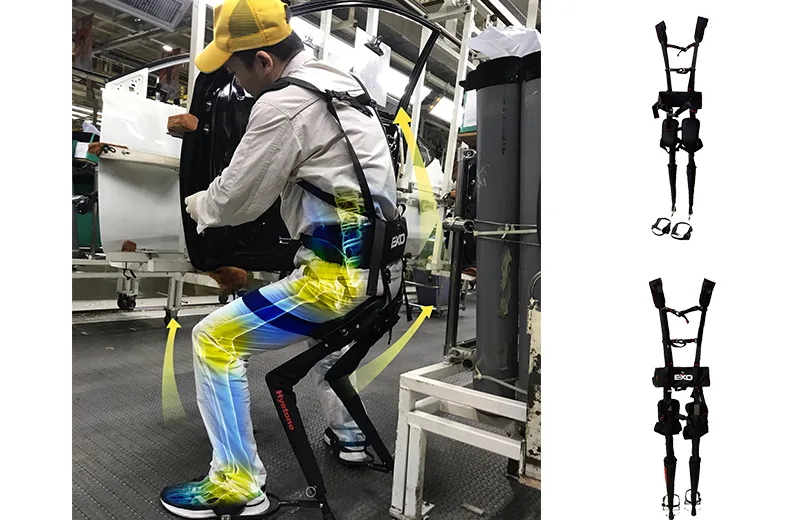
Overview of financial aid available for purchasing exoskeletons: CARSAT, AGEFIPH, FIPHFP grants, prevention contracts, a
Lire →